
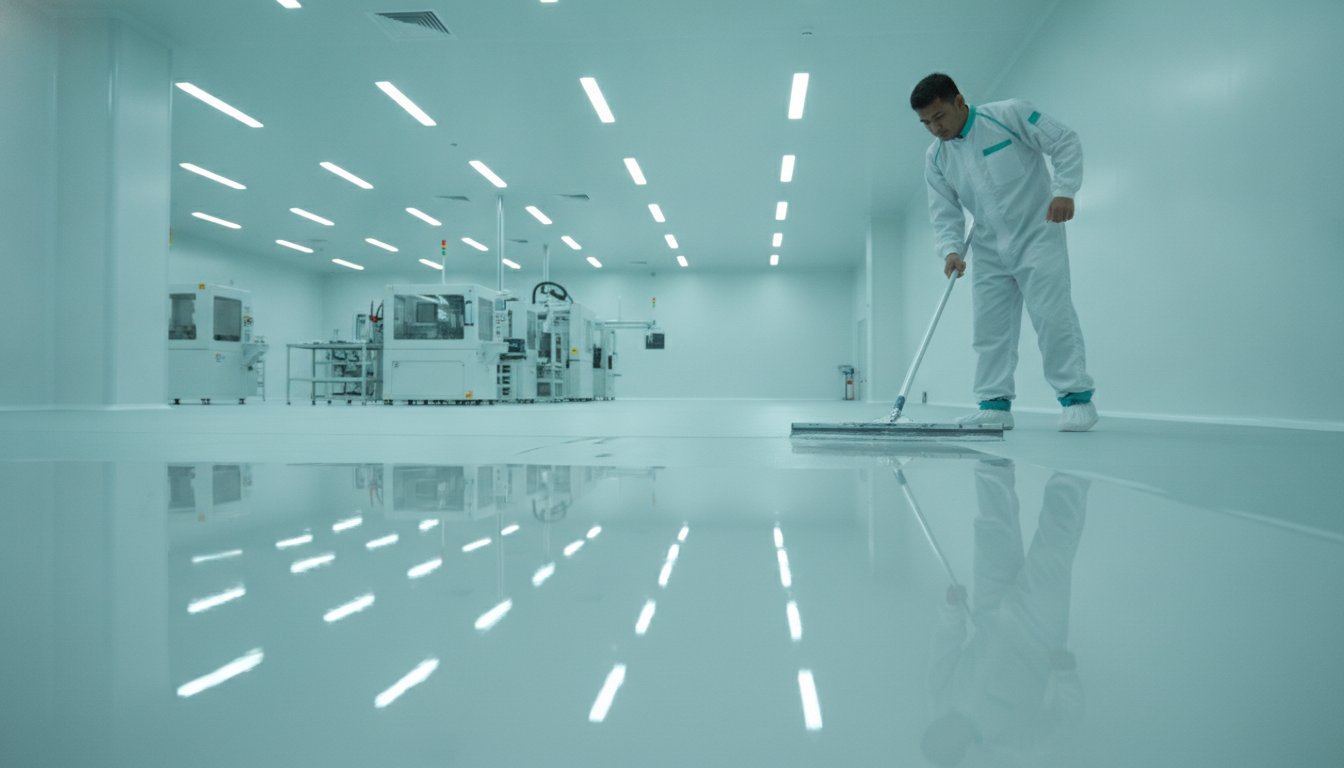
What if the floor your technicians walk on every day is the silent culprit behind your most expensive component failures? In the precision-driven world of electronics assembly, even a minor electrostatic discharge of 100 volts can decimate product yields. It’s a high-stakes environment where the fear of random static damage is a constant reality for plant managers across Malaysia. You understand that maintaining strict compliance with the ANSI/ESD S20.20-2021 standard isn’t just about passing an audit; it’s about ensuring the long-term stability of your production line. Many facility owners worry that their specialized surfaces will lose conductivity over time, leaving their sensitive components vulnerable.
This guide provides the technical clarity needed to select, install, and maintain high-performance ESD flooring for electronics manufacturing. We’ll explore how to achieve a system resistance of less than 3.5 x 10⁷ ohms through the synergy of conductive underlayments and resilient resinous topcoats. By the end of this article, you’ll have a clear roadmap for implementing a durable static control system that meets international benchmarks and protects your operational bottom line. We’ll cover everything from material selection between epoxy and PU systems to the rigorous testing protocols required for modern factory compliance.
Key Takeaways
- Identify how to mitigate product yield loss by aligning your facility with current ANSI/ESD S20.20-2021 performance standards.
- Select the most durable ESD flooring for electronics manufacturing by comparing the chemical resistance of epoxy systems with the impact flexibility of PU solutions.
- Recognize critical installation factors for the Malaysian climate, such as substrate moisture testing, to ensure your flooring doesn’t suffer from adhesion failure.
- Learn why standard industrial floor waxes can destroy static control properties and how to implement a compliant resistance monitoring schedule.
- Understand the multi-layer anatomy of conductive flooring to ensure a reliable path to ground for technicians and automated equipment.
The Critical Role of ESD Flooring in Electronics Manufacturing
Electrostatic discharge (ESD) is the uncontrolled transfer of stationary electricity between two objects with different potentials. In the context of semiconductor manufacturing, these events are often invisible yet catastrophic. A single discharge as low as 100 volts can compromise the internal circuitry of a microprocessor. For this reason, ESD flooring for electronics manufacturing is a mandatory infrastructure requirement rather than an optional finish. While some components fail immediately, others suffer from latent defects. These are microscopic weaknesses that pass initial quality checks but lead to premature failure once the product is in the consumer’s hands. For Malaysian manufacturers, this results in increased warranty claims and a damaged brand reputation.
Traditional industrial coatings are designed for mechanical durability and chemical resistance. However, standard epoxy is an insulator. It allows static electricity to accumulate on personnel and equipment. High-performance ESD flooring for electronics manufacturing is engineered to provide a controlled path to ground. This system performs a dual function: it suppresses the generation of static during movement and safely dissipates any existing charges before they can reach sensitive components. By creating a continuous conductive circuit, the floor ensures that every person and piece of equipment remains at the same electrical potential as the Earth.
Understanding Static Control Standards
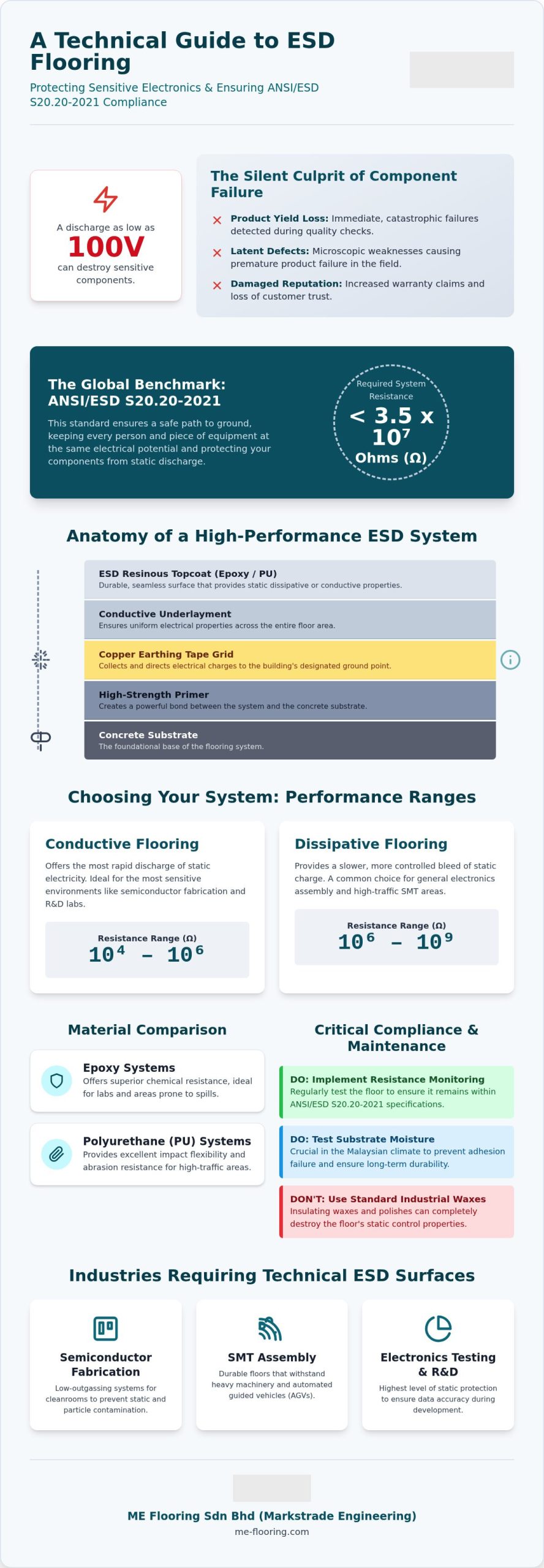
The global benchmark for these systems is ANSI/ESD S20.20-2021. This performance-based standard requires that the combined resistance of the person, footwear, and flooring remains below 3.5 x 10⁷ ohms. Adhering to these specifications is essential for facilities seeking ISO 9001 or specialized electronics certifications. In 2026, industry trends show a move toward even more stringent body voltage requirements. Modern facilities often limit walking voltage to well under 100 volts to accommodate the ongoing miniaturization of sensitive components. This level of precision is only achievable through a professionally installed resinous system that maintains its conductivity across the entire surface area.
Industries Requiring Technical ESD Surfaces
Precision electronics manufacturing encompasses several distinct environments that demand specialized conductive surfaces to maintain operational safety.
- Semiconductor Fabrication: Cleanrooms require low-outgassing ESD systems to prevent both static events and particle contamination that can ruin silicon wafers.
- Surface Mount Technology (SMT) Assembly: High-speed automated assembly areas need floors that can withstand heavy machinery while maintaining constant conductivity for automated guided vehicles (AGVs).
- Electronics Testing and R&D: Environments where prototype components are handled require the highest level of static protection to ensure data accuracy and component safety during development.
Technical Specifications: How ESD Flooring Systems Work
A high-performance resinous system is more than a surface finish; it’s a precision-engineered electrical circuit. To achieve the reliability required for ESD flooring for electronics manufacturing, the installation follows a rigorous multi-layer anatomy. The process begins with a high-strength primer that secures the system to the concrete substrate. Above this, a conductive grid of copper earthing tapes is installed. These tapes serve as the primary conduits, collecting electrical charges from the surface and directing them to the building’s designated earth point. A specialized conductive underlayment is then applied to provide a uniform foundation, ensuring that the final ESD-safe topcoat maintains consistent electrical properties across the entire floor area.
Electrical performance is categorized by resistance, measured in Ohms. Facility managers must choose between conductive and dissipative ranges based on their specific operational risks. Conductive flooring typically maintains a resistance between 1.0 x 10^4 and 1.0 x 10^6 Ohms, offering the most rapid discharge of static. Dissipative systems range from 1.0 x 10^6 to 1.0 x 10^9 Ohms, providing a slower, more controlled bleed of electricity. Selecting the correct range depends on the sensitivity of the components handled and the specific safety requirements of the production environment. For those managing complex facility upgrades, consulting with a specialist in high-performance industrial coatings ensures the system meets these precise technical benchmarks.
Conductivity Mechanisms in Resinous Floors
Resinous systems achieve their electrical properties through the integration of carbon particles or conductive fibres within the polymer matrix. These materials create a microscopic network that facilitates charge transport through the non-conductive resin. The uniformity of the conductive underlayment is critical; any gaps in this layer can lead to “dead spots” where static can accumulate. The path to ground is the continuous, low-resistance circuit that directs static electricity from the floor surface through the conductive layers and copper tapes into the building’s earth system.
Walking Body Voltage (WBV) Explained
Static generation is often the result of triboelectric charging, which occurs when a technician’s footwear makes and breaks contact with the floor. While resistance testing is a standard metric, modern QA audits increasingly focus on Walking Body Voltage (WBV). This test measures the actual voltage generated on a person’s body while moving across the surface. In 2026, the industry standard for sensitive electronics handling is to maintain a WBV of less than 100 volts. Achieving this requires a synergistic relationship between the flooring material and ESD-compliant footwear, ensuring that charges are suppressed at the moment of generation.
Comparing ESD Flooring Systems: Epoxy vs. PU vs. Vinyl
Selecting the optimal material for ESD flooring for electronics manufacturing involves a critical evaluation of mechanical stress and environmental conditions. Vinyl sheets and tiles are frequently considered for their low initial cost and speed of application. However, these systems rely on adhesives that are susceptible to failure in the presence of moisture or heavy rolling loads. In Malaysian factories, the seams in vinyl flooring often become traps for debris or moisture, compromising the floor’s integrity. Seamless resinous systems, such as epoxy and polyurethane, provide a superior alternative by creating a continuous conductive surface that eliminates these vulnerabilities.
A strategic lifecycle cost analysis shows that while resinous systems require a higher upfront investment, they avoid the recurring maintenance costs associated with vinyl. Repairs to damaged tiles or failing seams can disrupt production and compromise ESD safety. Investing in a durable resin system ensures that the facility remains compliant without the need for frequent, costly interventions. For a plant manager, the goal is to minimize downtime; a floor that lasts ten years without failure is more valuable than one that’s cheaper to install but requires annual repairs.
When to Choose Epoxy ESD Systems
Epoxy Self Levelling is the preferred solution for environments that demand extreme hardness and chemical resistance. This system is ideal for cleanrooms and laboratories where hygiene is paramount. Its dense surface resists penetration from oils and solvents, making it easy to maintain with specialized ESD cleaners. Epoxy is particularly effective in areas with high trolley traffic, as its rigid structure prevents the surface from deforming under the concentrated weight of small wheels. It’s a proven choice for facilities focusing on high-precision SMT assembly.
The Advantages of PU ESD for Heavy-Duty Plants
PU Self Levelling and PU Heavy Duty systems offer a level of flexibility that epoxy lacks. This elasticity is vital for large-scale manufacturing plants where heavy machinery creates significant vibration and thermal shifts. Polyurethane systems can absorb impact and bridge minor substrate cracks without losing their conductive properties. Additionally, these floors provide better acoustic insulation and ergonomic comfort for assembly line workers who remain on their feet for extended shifts. For facilities that require both static control and exceptional structural resilience, understanding the full performance capabilities of heavy duty PU flooring Malaysia specialists recommend is essential to making the right long-term investment. It’s the technical choice for environments where durability and worker welfare are equally prioritized.
Installation Standards and Malaysian Factory Requirements
Successful implementation of ESD flooring for electronics manufacturing depends entirely on the precision of the installation process. In Malaysia, the tropical climate introduces specific challenges, most notably high relative humidity and high substrate moisture levels. Before any resin is applied, the concrete slab must undergo rigorous moisture testing. We utilize digital hygrometers or calcium chloride tests to ensure the moisture vapor emission rate (MVER) is within the safe limits for resinous systems. Ignoring these environmental factors leads to osmotic blistering, where moisture trapped beneath the floor causes the coating to delaminate and lose its conductive properties.
Mechanical surface preparation is the next mandatory step in ensuring a long-term bond. We utilize diamond grinding for most electronics facilities to achieve a smooth, consistent profile, though shot blasting may be required for heavier PU Heavy Duty systems. This process removes laitance and opens the concrete pores for maximum adhesion. Once the surface is prepared, a copper grounding grid is installed. These conductive tapes are typically laid in a 5-meter by 5-meter grid across the floor and connected to the building’s designated earth point. This grid is the primary infrastructure that ensures every square centimeter of the floor has a reliable path to ground. For a professional assessment of your facility’s requirements, you can contact our technical team for a site evaluation.
Substrate Preparation and Priming
The concrete slab must be completely free from oils, dust, and previous coatings that could act as insulators. We meticulously address all cracks and expansion joints using specialized fillers to prevent telegraphing through the final ESD surface. Following repair, we apply a high-strength conductive primer. This layer serves as the electrical foundation, bridging the gap between the copper tapes and the conductive topcoat to ensure uniform resistance levels across the entire production area.
Environmental Controls During Application
Managing the ambient environment is critical during the curing phase of resinous floors. High humidity can interfere with the chemical reaction of the epoxy or PU, leading to a tacky finish or inconsistent conductivity. We monitor the dew point closely; the slab temperature must remain at least 3 degrees Celsius above the dew point to prevent condensation from forming on the uncured resin. Professional application by a seasoned specialist is mandatory to guarantee that the finished system adheres to the strict resistance parameters required for ANSI/ESD S20.20-2021 compliance.
Post-installation quality control involves rigorous testing of point-to-point (Rpp) and point-to-ground (Rtg) resistance. These measurements confirm that the floor operates within the specified Ohmic range. We document these readings to provide facility managers with the necessary proof of compliance for their internal audits and ISO certifications. This methodical approach ensures the floor doesn’t just look professional but functions as a reliable safety system for years to come.
Ensuring Long-Term ESD Compliance and Durability
The integrity of ESD flooring for electronics manufacturing depends on rigorous post-installation care. Many facilities make the mistake of treating these technical surfaces like standard concrete. Using generic floor waxes or high-gloss sealers is a common error; these products are typically insulators that create a non-conductive film over the resin. This film effectively severs the path to ground, rendering the entire system useless. Maintaining compliance requires a disciplined approach to chemical selection and mechanical cleaning. This isn’t just a floor finish. It’s a technical safety system.
Physical durability is equally important for maintaining electrical performance. While Epoxy Self Levelling and PU Heavy Duty systems are designed for industrial wear, they aren’t indestructible. Heavy machinery or dragged equipment can cause gouging. Deep abrasions can cut through the conductive layers or damage the copper earthing tapes underneath. Our experience across over 360 industrial projects has shown that the foundation of longevity is the bond strength of the initial application. By choosing a partner that prioritizes technical performance over aesthetic shortcuts, you ensure that the floor’s electrical properties remain stable for its entire service life. When selecting a system for ESD flooring for electronics manufacturing, longevity is the primary metric of value.
Maintenance Protocols for Conductive Surfaces
Cleaning agents must be pH-neutral and specifically formulated for ESD environments. Standard detergents often leave behind surfactants that attract dust, leading to “dirt masking.” This layer of grime acts as a barrier between the technician’s footwear and the conductive floor, increasing resistance levels. For large-scale environments, we recommend using automatic scrubbers equipped with non-abrasive pads. This ensures consistent soil removal without scratching the resinous topcoat or degrading the conductive network within the floor.
Annual Audits and Recertification
Preparing for customer and third-party ESD audits is a high-stakes process for Malaysian semiconductor firms. Auditors look for consistency in Rpp (point-to-point) and Rtg (point-to-ground) measurements across the entire floor area. We provide the technical documentation and initial baseline readings that serve as the foundation for these audits. If localized issues are identified, they’re often due to surface contamination or minor physical damage. These areas can usually be restored through deep cleaning or specialized patch repairs. Planning Your Industrial Epoxy Floor Installation with a specialist who understands these long-term compliance requirements is the most effective way to avoid costly recertification failures.
Securing Future-Proof Static Control for Your Facility
Implementing high-performance ESD flooring for electronics manufacturing is a critical investment in your facility’s long-term operational stability. Throughout this guide, we’ve detailed how technical mastery in material selection and rigorous installation standards protect your sensitive components from catastrophic static events. Whether you choose the chemical resilience of epoxy systems or the impact flexibility of PU solutions, the priority remains a reliable, documented path to ground that meets ANSI/ESD S20.20-2021 requirements.
Maintaining these standards requires more than just the right materials; it demands a partner with a proven track record in high-stakes industrial environments. With over 360 completed industrial projects across Malaysia, ME Flooring Sdn Bhd provides the expert technical support needed to ensure your surfaces remain compliant and durable under constant traffic. Don’t leave your product yield to chance by relying on inferior finishes or improper maintenance protocols. We’re ready to help you establish a secure, static-safe environment that supports your factory’s growth and compliance goals.
Consult ME Flooring Sdn Bhd for a Technical ESD Flooring Assessment to secure your facility today.
Frequently Asked Questions
What is the difference between anti-static and ESD flooring?
Anti-static flooring primarily prevents the generation of static electricity as personnel move across the surface. However, it doesn’t necessarily provide a path to ground for existing charges. In contrast, ESD flooring for electronics manufacturing is engineered to both suppress charge generation and safely dissipate existing static into the building’s earthing system. This makes ESD systems the mandatory standard for sensitive semiconductor environments where controlled resistance levels are strictly required.
How often should I test my ESD floor for resistance?
You should perform resistance testing monthly for high-traffic production areas and annually for the entire facility to ensure ongoing compliance. ANSI/ESD S20.20-2021 recommends regular verification to identify localized loss of conductivity or surface contamination. We recommend keeping a formal log of point-to-point and point-to-ground measurements. This documentation is essential for passing third-party audits and maintaining your ISO certifications within the Malaysian electronics sector.
Can I apply an ESD coating over my existing epoxy floor?
Applying an ESD coating directly over an existing non-conductive epoxy floor isn’t a viable technical solution. The existing floor acts as an insulator, preventing a reliable path to ground. To install a functional system, the old coating must be removed via diamond grinding to expose the concrete substrate. This allows for the installation of the copper grounding grid and conductive primer, which are the foundational elements of any compliant surface.
Does ESD flooring require special footwear to be effective?
Yes, ESD flooring is only one half of a complete static control system. For the floor to dissipate charges, personnel must wear ESD-compliant footwear or heel straps that create an electrical connection between the body and the floor. Without this connection, a person can still generate and carry a static charge even while standing on a conductive surface. This synergistic relationship is critical for maintaining body voltage levels below 100 volts.
How long does a professional ESD floor installation take?
A standard professional installation typically requires four to seven days depending on the facility size and substrate condition. This timeline includes mechanical surface preparation, crack repair, the installation of the copper grounding grid, and the application of multiple resin layers. Each layer requires specific curing times that are influenced by Malaysia’s local humidity levels. Rushing the curing process can compromise the floor’s long-term adhesion and electrical performance.
What are the most common causes of ESD flooring failure?
The most frequent causes of failure include inadequate substrate preparation and high moisture vapor emission from the concrete slab. In tropical climates, trapped moisture can lead to osmotic blistering, which physically destroys the resin bond. Additionally, using insulating floor waxes or improper cleaning chemicals can mask the conductive properties of the surface. These issues lead to dead spots where the floor no longer provides a reliable path to ground.
Is ESD flooring suitable for cleanroom environments?
Yes, specialized resinous systems are engineered specifically for cleanroom environments. These floors are seamless and non-porous, preventing the accumulation of dust and microbial contaminants. High-quality ESD flooring for electronics manufacturing also features low-outgassing properties, which is essential for maintaining air purity in semiconductor fabrication areas. The combination of static control and hygiene makes resinous systems superior to tiled alternatives that have problematic seams that can trap particulates.
How do I clean an ESD floor without losing its conductivity?
You must use pH-neutral, non-insulating cleaning agents designed specifically for conductive surfaces. Avoid standard commercial waxes or silicone-based cleaners, as these leave a film that blocks the path to ground. Regular cleaning with an automatic scrubber and non-abrasive pads is recommended to prevent dirt masking. Removing surface contaminants ensures that the electrical resistance remains within the specified Ohmic range required for your facility’s safety and compliance standards.




Add comment